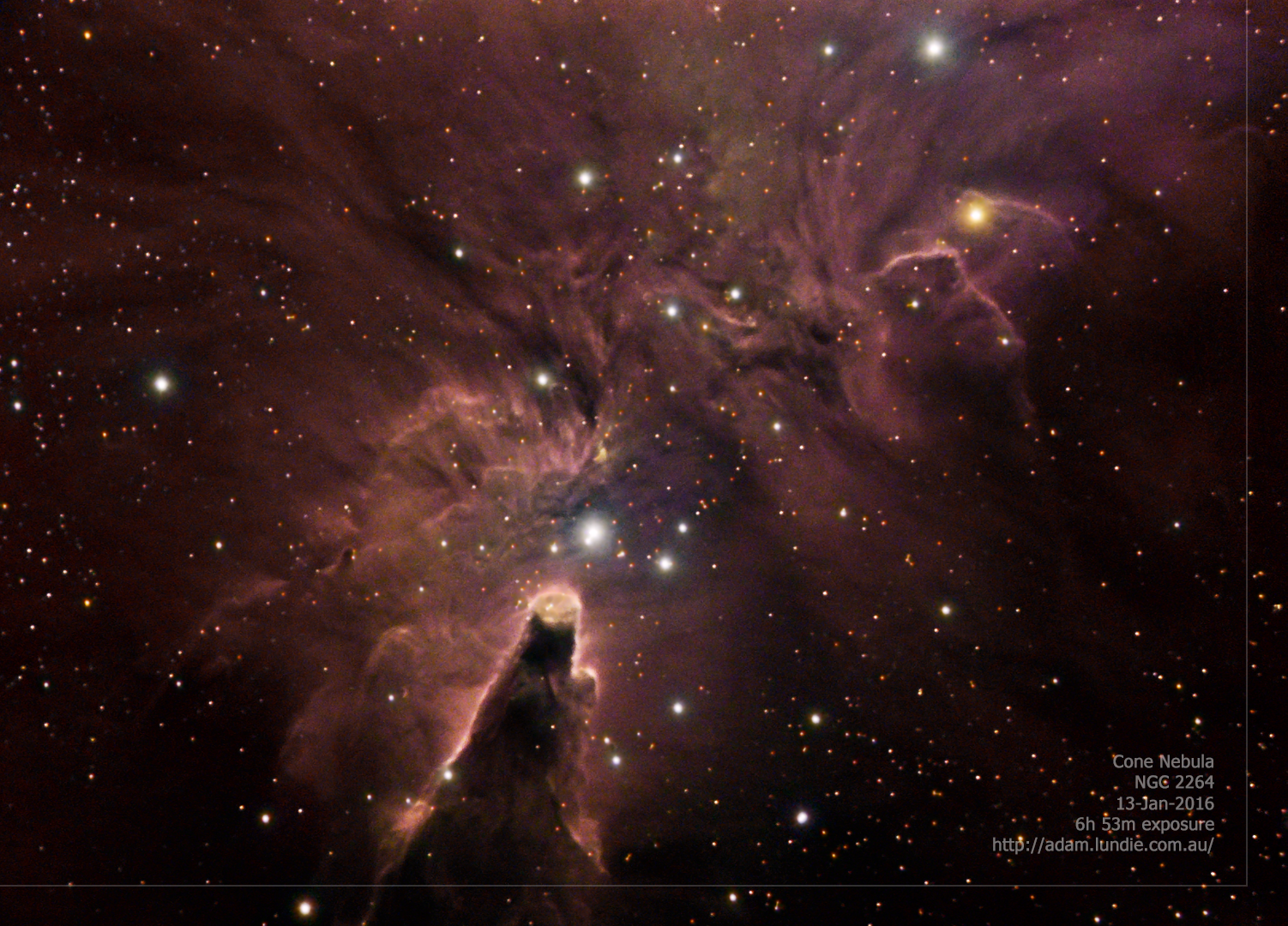
BEHIND THE IMAGE
Notes from the session
Image:
24x 300s luminance bin2x2 + 20x flat + 50x dark + 120x bias
20x 600s Hα bin2x2 + 10x flat + 50x dark + 120x bias
10x 200s red bin3x3 + 30x flat + 50x dark + 120x bias
8x 200s green bin3x3 + 30x flat + 50x dark + 120x bias
10x 200s blue bin3x3 + 30x flat + 50x dark + 120x bias
Total exposure time: 6 hours 53 minutes.
Hardware:
Celestron EdgeHD 1100 with CGEM DX mount
Celestron 0.7x EdgeHD focal reducer
QSI 683-wsg Camera @ -15°C
Astronomik Type 2c LRGB filters
Astronomik Hα 6nm filter
Orion StarShoot Autoguider
Starlight Xpress Adaptive Optics
Location:
Orange zone in Brisbane, Australia. (Bortle 7)
Imaging over 7 nights - average to above average seeing + new moon.
Software:
Captured with AstroArt 6
Guiding with PHD2 + PHD_Dither
Aladin 8.0: Planning & camera alignment.
CCDInspector: Image analysis & rejection
CCDStack 2+: Calibrate, align, normalize, stack, curves, deconvolve luminance, combine RGB.
Photoshop CC: Reduce noise, integrate L+Ha+RGB, high pass filter, unsharp mask, shrink stars, color balance.