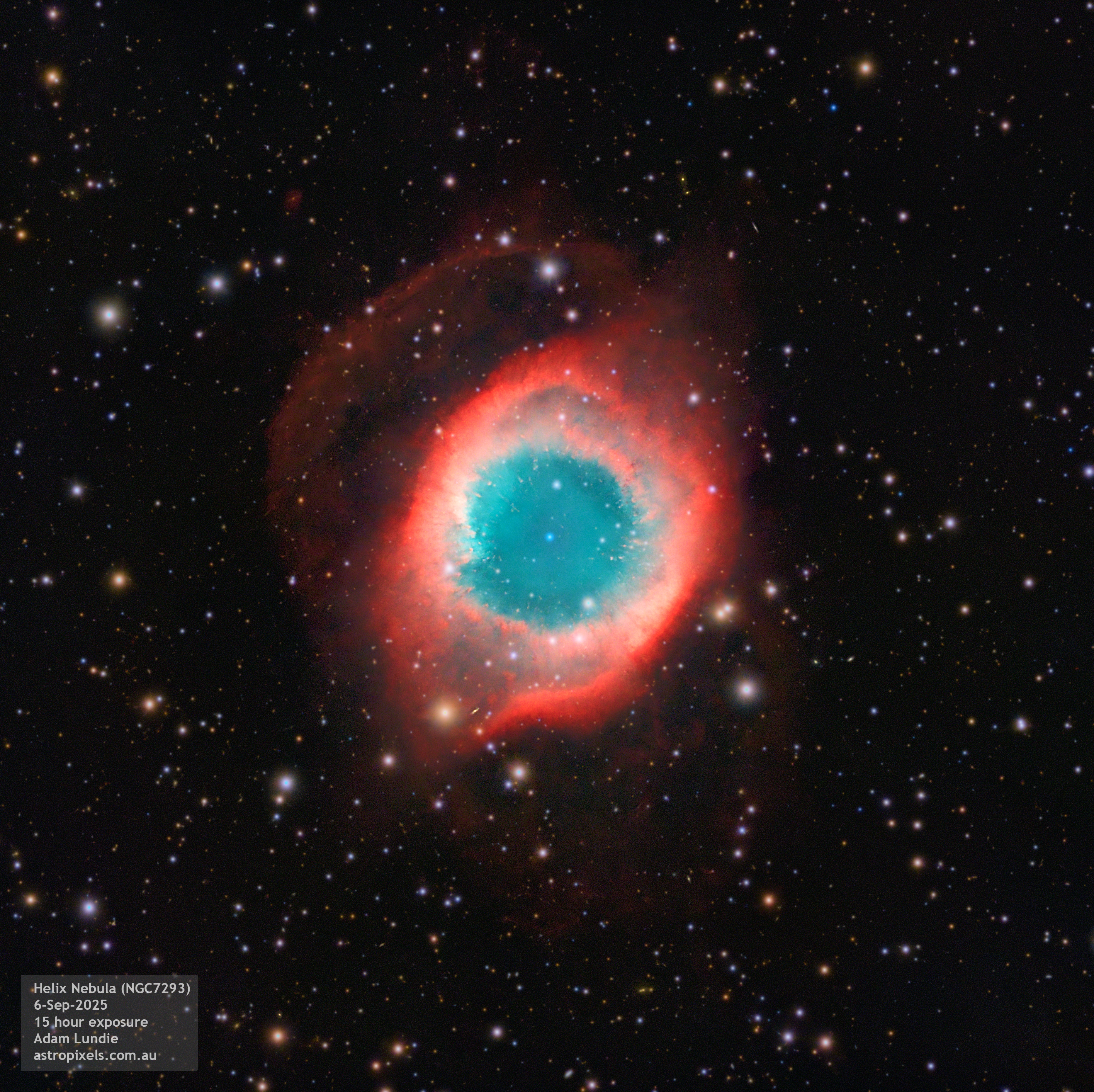
Helix Nebula
The Helix Nebula (NGC 7293), is a large planetary nebula located in the constellation Aquarius, 695 light years away.
Read the session notes ↗Existing imaging notes, equipment details and processing stories, in the photographer’s own words.
The Helix Nebula (NGC 7293), is a large planetary nebula located in the constellation Aquarius, 695 light years away.
Read the session notes ↗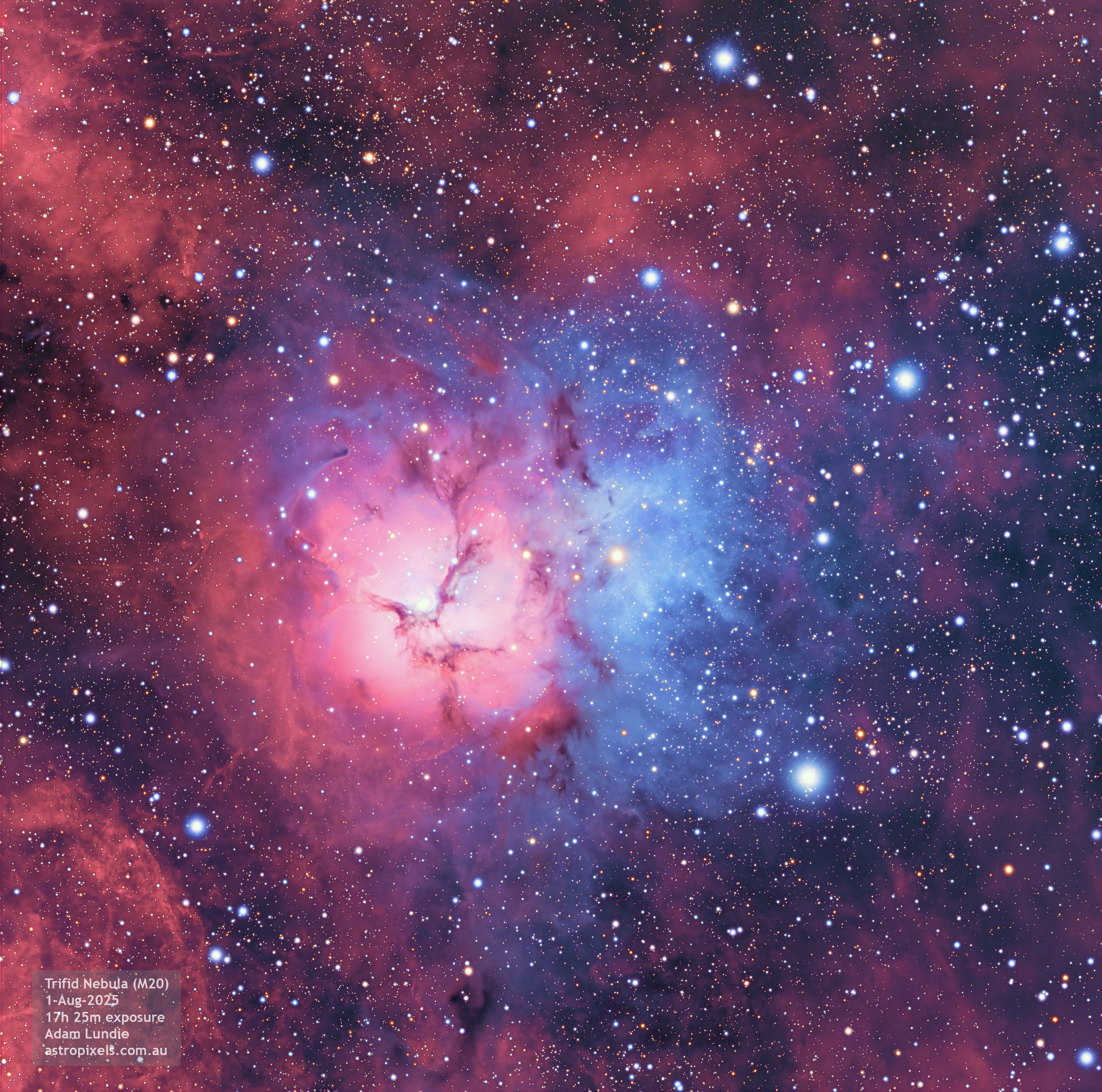
A swirl of stellar creation, the Trifid Nebula (M20) reveals its dual personality here: rose-pink hydrogen emission framed by the cool, silvery glow of reflected starlight. Dark dust lanes slice the central clo
Read the session notes ↗
NGC 210 is a spiral galaxy in the constellation Cetus, situated roughly 70 million light-years from Earth. In this photograph, the galaxy's grand design is evident, with its pronounced spiral arms and central b
Read the session notes ↗
When stars like the Sun are near end of life, they send their outer layers into space to create glowing clouds of gas, a planetary nebulae. This ejection of mass is uneven, and planetary nebulae can have comple
Read the session notes ↗
Perhaps too small of an object for amateur equipment to tease out any details, I decided to try my luck on the Little Gem Nebula. NGC 6818 is roughly 6000 light-years away from Earth. The glow of the cloud is j
Read the session notes ↗
First Calalogued in 1752, the NGC 3532, also known as the Wishing Well Cluster is an open cluster comprised of approximately 150 stars. It was also the first object ever observed by the Hubble Space Telescope.
Read the session notes ↗
NGC 1398 is a barred spiral galaxy with double ring structure 65 million light years distant.
Read the session notes ↗
With more than 16 galaxies in one very narrow field of view, the elliptical galaxy NGC6876 is centered, interacting with NGC6877. In the bottom right, the spiral arms of NGC6872 are spread out by the interactio
Read the session notes ↗
Although categorised as a hydrogen emission nebula, Sh2-63 lacks the bright red colouring typical of similar objects.
Read the session notes ↗
This interacting trio of galaxies is known as the Lyon Group of Galaxies 455, made up of the galaxies NGC 7233 (middle), NGC 7232 (upper), and NGC 7232B (right).
Read the session notes ↗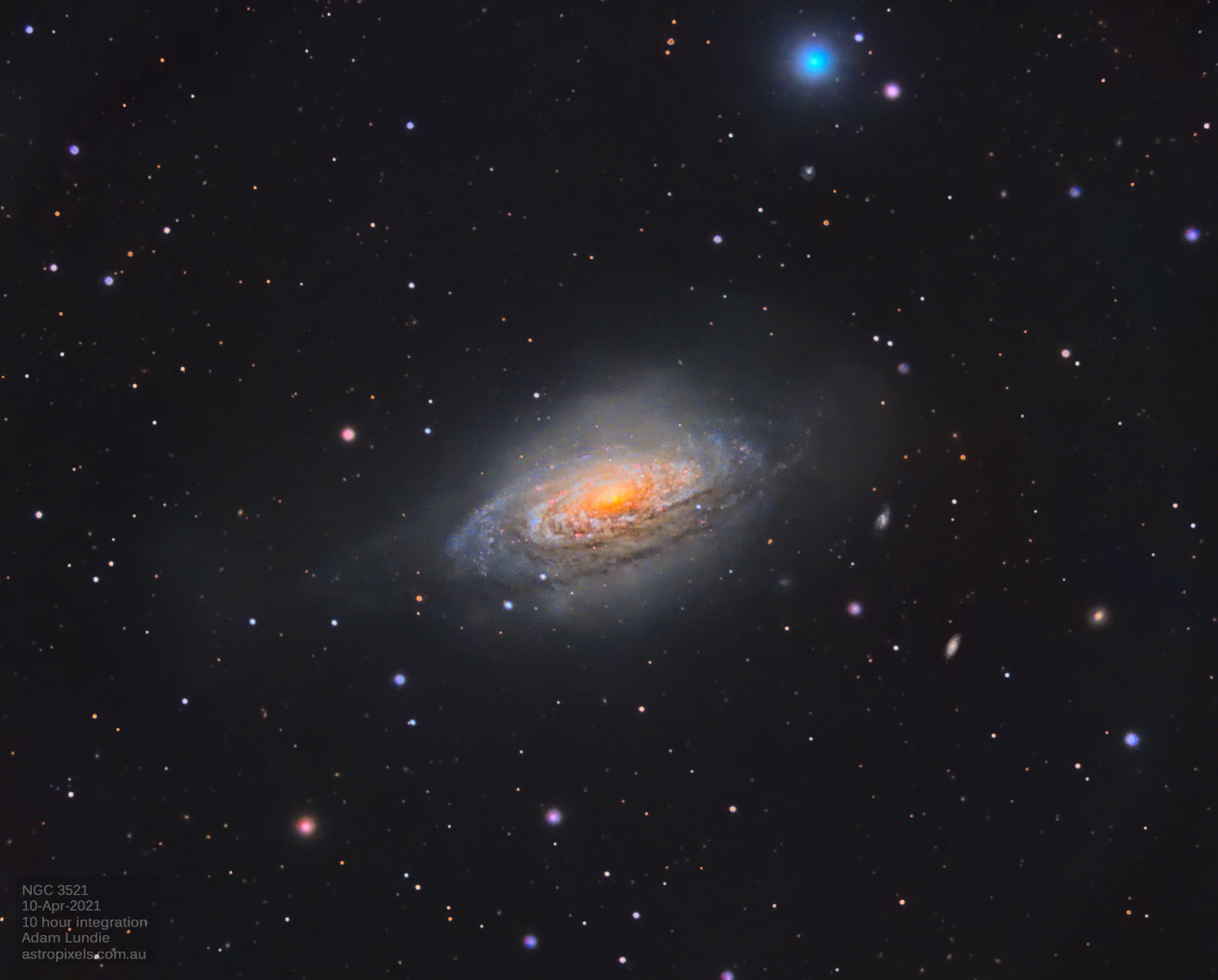
NGC 3521 is a flocculent spiral galaxy located 26 million light-years away from Earth
Read the session notes ↗
NGC 5068 is a seldom photographed face-on galaxy sporting a bright central bar with diffuse spiral arms containing areas of pink hydrogen nebulosity and star-forming regions.
Read the session notes ↗
Categorised as a supermassive disk galaxy, at a distance of 80 million light years and 200,000 light years across, NGC 5084 is one of the largest galaxies in the Virgo Supercluster. Seen edge on, the warped dis
Read the session notes ↗
Stars such as our Sun do not contain enough mass to finish their lives in the glorious explosions known as supernovae. However, they are still able to salute their imminent demise into dense, Earth-sized embers
Read the session notes ↗
The Red Spider Nebula (also catalogued as NGC 6537) is a planetary nebula located near the heart of the Milky Way.
Read the session notes ↗
NGC 6744 (Caldwell 101) is a spiral galaxy about 31 million light-years away, tilted towards our line of sight. It is thought to be one of the most Milky Way-like spiral galaxies in our immediate vicinity. It a
Read the session notes ↗
IC 4601 is a reflection nebula within the larger Blue Horsehead Nebula. Reflection nebulae are actually made up of dust that normally appears dark but can reflecting the light of nearby stars.
Read the session notes ↗
NGC5710 is a rarely photographed spiral galaxy approximately 96 million light years distant. The core is comprised of old yellow stars, with young blue stars in its spiral arms, obscured by prominent dust lanes
Read the session notes ↗A collection of astronomical photographs by Adam Lundie. Explore the images, then look behind the scenes at the exposures, equipment and processing that brought them into view.
Inside the imaging sessions ↗