
Saturn Nebula
The Saturn Nebula is a tiny but complex planetary nebula, ~4000 light years away in Aquarius. The Saturn Nebula gets its name from its resemblance to the planet Saturn to the observer.
Read the session notes ↗Existing imaging notes, equipment details and processing stories, in the photographer’s own words.
The Saturn Nebula is a tiny but complex planetary nebula, ~4000 light years away in Aquarius. The Saturn Nebula gets its name from its resemblance to the planet Saturn to the observer.
Read the session notes ↗
NGC 3717 is a large spiral galaxy 60 million light years from Earth. Although 100,000 light years across, seen side-on, the galactic disk appears thin with prominent dust lanes.
Read the session notes ↗
M68 is a globular cluster at a distance of about 33,000 light-years away from Earth.
Read the session notes ↗
NGC 2626 is a seldom photographed, spectacular reflection nebula in a sea of hydrogen emission clouds.
Read the session notes ↗
NGC 1808 has an unusual, warped shape. Most spiral galaxies are flat disks, but this one has curls of dust and gas at its outer spiral arms.
Read the session notes ↗
The Fornax Cluster is a cluster of 58 galaxies centered around 62 million light years distant.
Read the session notes ↗
This southern sky barred spiral galaxy shines bright in the southern skies, from about 45 million light-years away.
Read the session notes ↗
IC 5325 is a rarely photographed spiral galaxy in the Phoenix constellation
Read the session notes ↗
The Sculptor Galaxy, also known as the Silver Coin or Silver Dollar Galaxy, NGC 253, is an intermediate spiral galaxy in the constellation Sculptor. The Sculptor Galaxy is a starburst galaxy, which means that i
Read the session notes ↗
Perhaps too tough of a target for light polluted skies, elliptical galaxy NGC 474 still managed to show some tidal tails / shells from interacting with the nearby spiral galaxy NGC 470.
Read the session notes ↗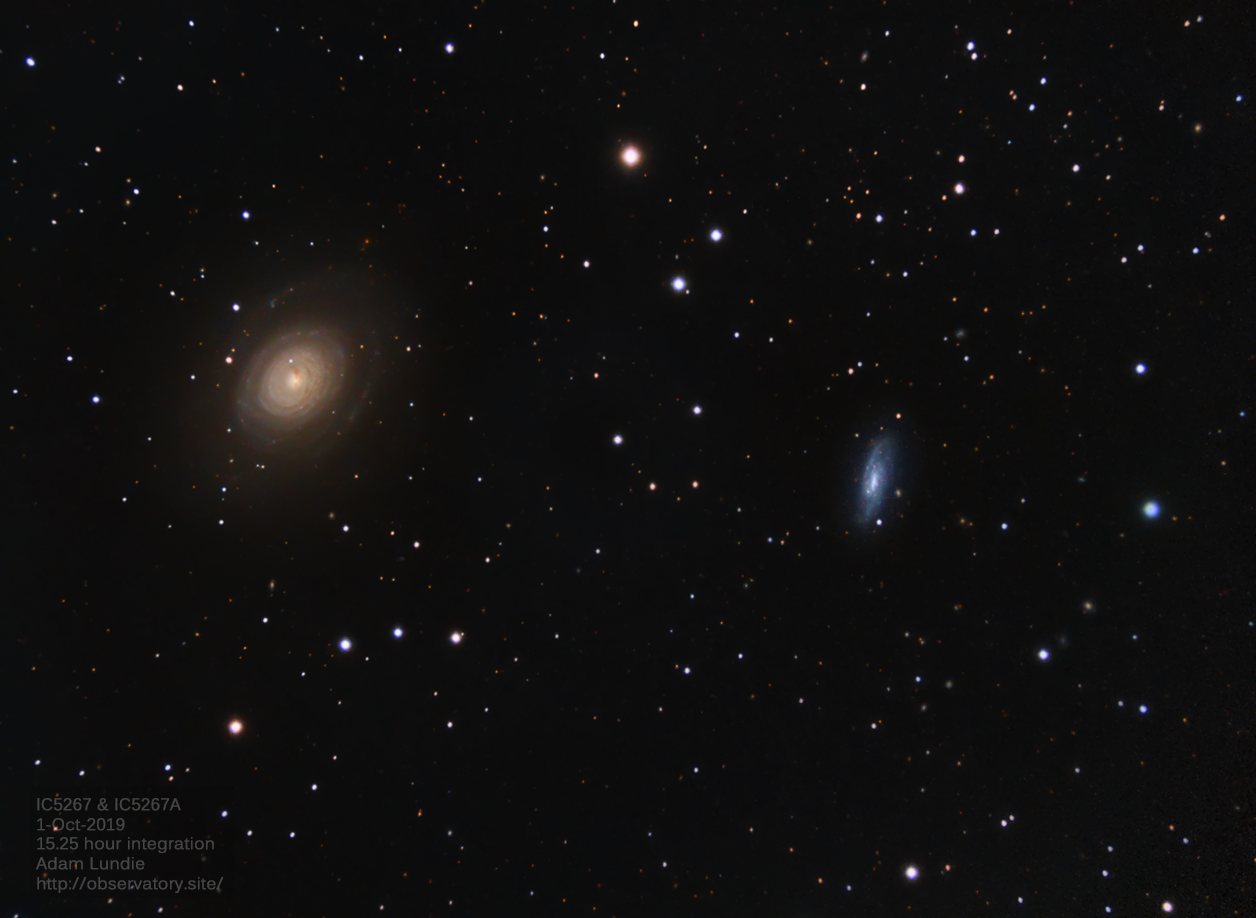
IC 5267 (left) is a spiral galaxy 79 million light years away.
Read the session notes ↗
Messier 15 is a very old and tightly packed home to over 100,000 stars. It is 33,600 light years from Earth, and is visible to the naked eye in areas with little light pollution.
Read the session notes ↗
NGC 7083 is a spiral galaxy located about 134 million light-years away.
Read the session notes ↗
At 180 million light years away, spiral galaxy NGC 6962 dominates this field of galaxies.
Read the session notes ↗
10600 light years away, Messier 22 is one of the closest and brightest globular clusters visible from Earth.
Read the session notes ↗
The dark molecular clouds of Barnard 92 (center) and 93 (left) are superimposed over the Messier 24 Sagittarius Star Cloud.
Read the session notes ↗
The Lagoon Nebula is an active stellar nursery spanning 60 light years across. This false color photograph shows the interplay of three gasses: hydrogen-alpha in green, sulfur-II in red, and oxygen-III in blue.
Read the session notes ↗
One of the few Messier objects difficult to observe in the northern hemisphere, M55 is a globular cluster 17,600 light years away, comprising of around 100,000 very old stars.
Read the session notes ↗A collection of astronomical photographs by Adam Lundie. Explore the images, then look behind the scenes at the exposures, equipment and processing that brought them into view.
Inside the imaging sessions ↗