THE PROCESS BEHIND THE PHOTOGRAPHS
Field notes.
Existing imaging notes, equipment details and processing stories, in the photographer’s own words.
 ↗
31-Aug-2018NGC7020
Ringed Galaxy NGC 7020
The southern galaxy NGC 7020 presents an unusual morphology: it includes a very regular outer ring which is completely detached and which envelops an inner ring/lens zone with a hexagon surrounding an X shape.
Read the session notes ↗ ↗
17-Aug-2018NGC 6935
Spiral Galaxies NGC6935 and NGC6937
NGC6935 and NGC6937 are two differing spiral galaxies that appear close to each other, though they are not gravitationally bound
Read the session notes ↗ ↗
14-Aug-2018Mars
Mars is Still Hazy
Mars is currently at it's closest to Earth since 2003, and appears as a brilliant red star in the sky. Unfortunately it is also suffering from a global dust storm, slowly abating.
Read the session notes ↗ ↗
10-Aug-2018Prawn Nebula
Prawn Nebula in Emission Line Color
IC 4628, sometimes known as The Prawn Nebula, is an emission nebula located around 6000 light-years away in the constellation Scorpius
Read the session notes ↗ ↗
10-Aug-2018Prawn Nebula
Prawn Nebula in Natural Color
IC 4628, sometimes known as The Prawn Nebula, is an emission nebula located around 6000 light-years away in the constellation Scorpius
Read the session notes ↗ ↗
03-Aug-2018NGC 6769
Colliding Galaxies NGC6769 NGC6770 NGC6771
A galactic merger is happening 165 million light years away between the spiral galaxies NGC 6769, 6770, 6771.
Read the session notes ↗ ↗
30-Jul-2018NGC6902
Spiral Galaxy NGC6902 and Friends
NGC 6902 is a spiral galaxy 33 million light years away in the Sagittarius constellation. It has a very bright center, with grand spiral arms extending out much further than the local light pollution allowed me
Read the session notes ↗ ↗
19-Jul-2018Cats Paw Nebula
Cats Paw Nebula
Shaped like a cats paw, NGC 6334 is a stellar nursery and emission nebula 5,500 light years away in the constellation Scorpius. This image comprises of emission line data for Sulfur-II, Hydrogen-alpha and Oxyge
Read the session notes ↗ ↗
11-Jul-2018Mars
Hazy Mars at Opposition
Mars is currently at it's closest to Earth since 2003, and appears as a brilliant red star in the sky. Unfortunately it is also suffering from a severe global dust storm, showing no signs of abating. This means
Read the session notes ↗ ↗
08-Jul-2018Jupiter
Jupiter July 2018
Jupiter is high in the skies just after dusk. I period of good seeing allowed me to capture more detail than I've managed before.
Read the session notes ↗ ↗
04-Jul-2018NGC 6188
Ara Dragons NGC6188
NGC 6188 is a large emission nebula of compressed molecular clouds 4,000 light years away in the constellation Ara. This image spans around 3 full moons and comprises of emission line data for Sulfur-II, Hydrog
Read the session notes ↗ ↗
13-Jun-2018NGC 5921
Barred Spiral Galaxy NGC5921
The barred grand spiral galaxy NGC 5921 lies 65 million light years away. It was discovered by William Herschel on 1 May 1786. There are several background galaxies present in the image.
Read the session notes ↗ ↗
07-Jun-2018Asteroid
Asteroid 2000 AJ129 Passing NGC5921
While looking through the data captured of NGC 5921, I discovered a very dim object slowly moving through the field of view. The object has been identified as main belt asteroid 2000 AJ129, magnitude 15.
Read the session notes ↗ ↗
04-Jun-2018Shapley 1
Shapley 1 Planetary Nebula
Shapley 1 is a planetary nebula in the southern sky with a magnitude 14 white dwarf at it's center. It is approximately 4900 light years away, and one third of a light year across.
Read the session notes ↗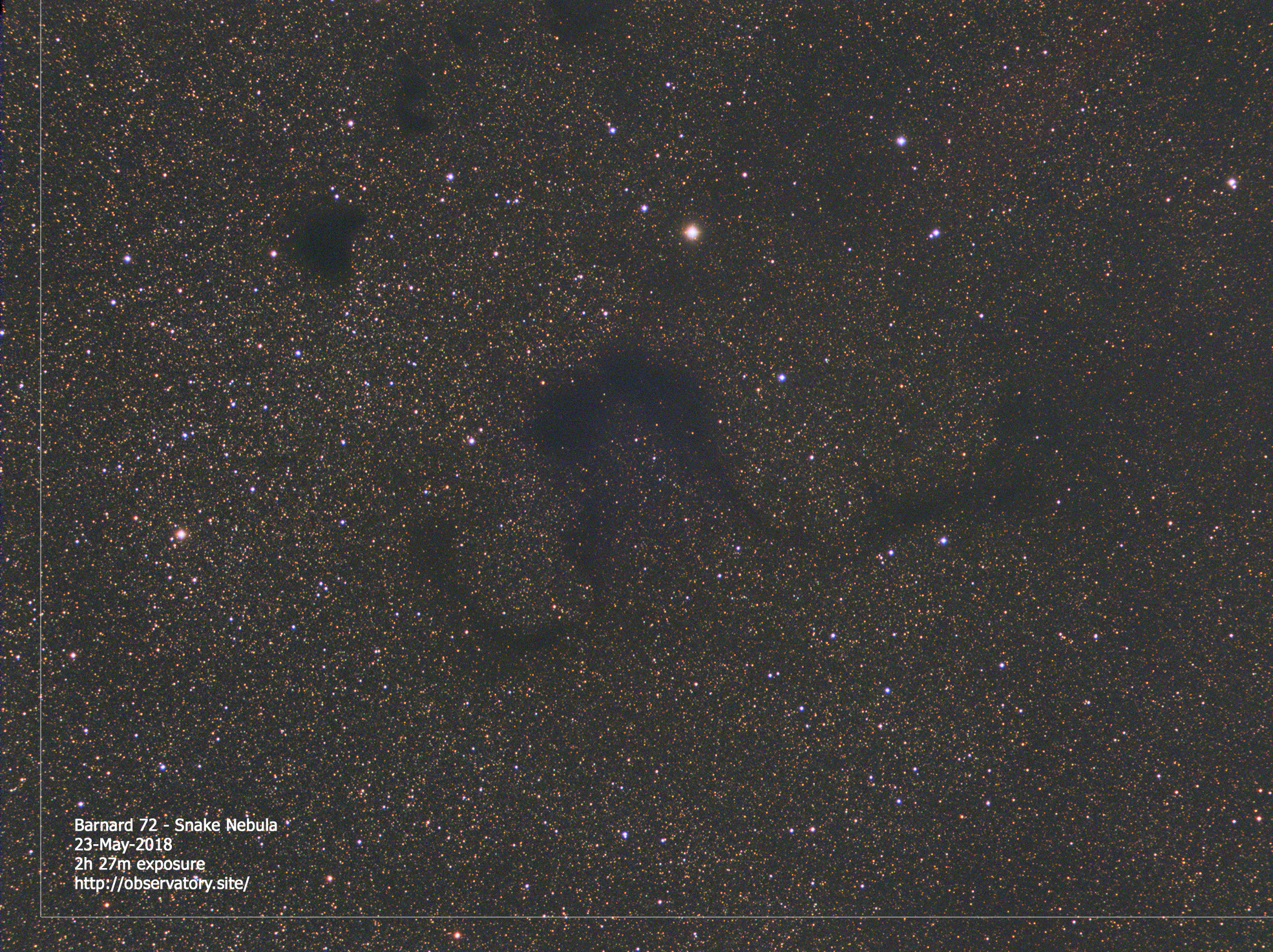 ↗
24-May-2018Snake Nebula
Snake Nebula
The Snake Nebula (also known as Barnard 72) is a small but S-shaped dust lane that snakes out in front of the Milky Way star clouds.
Read the session notes ↗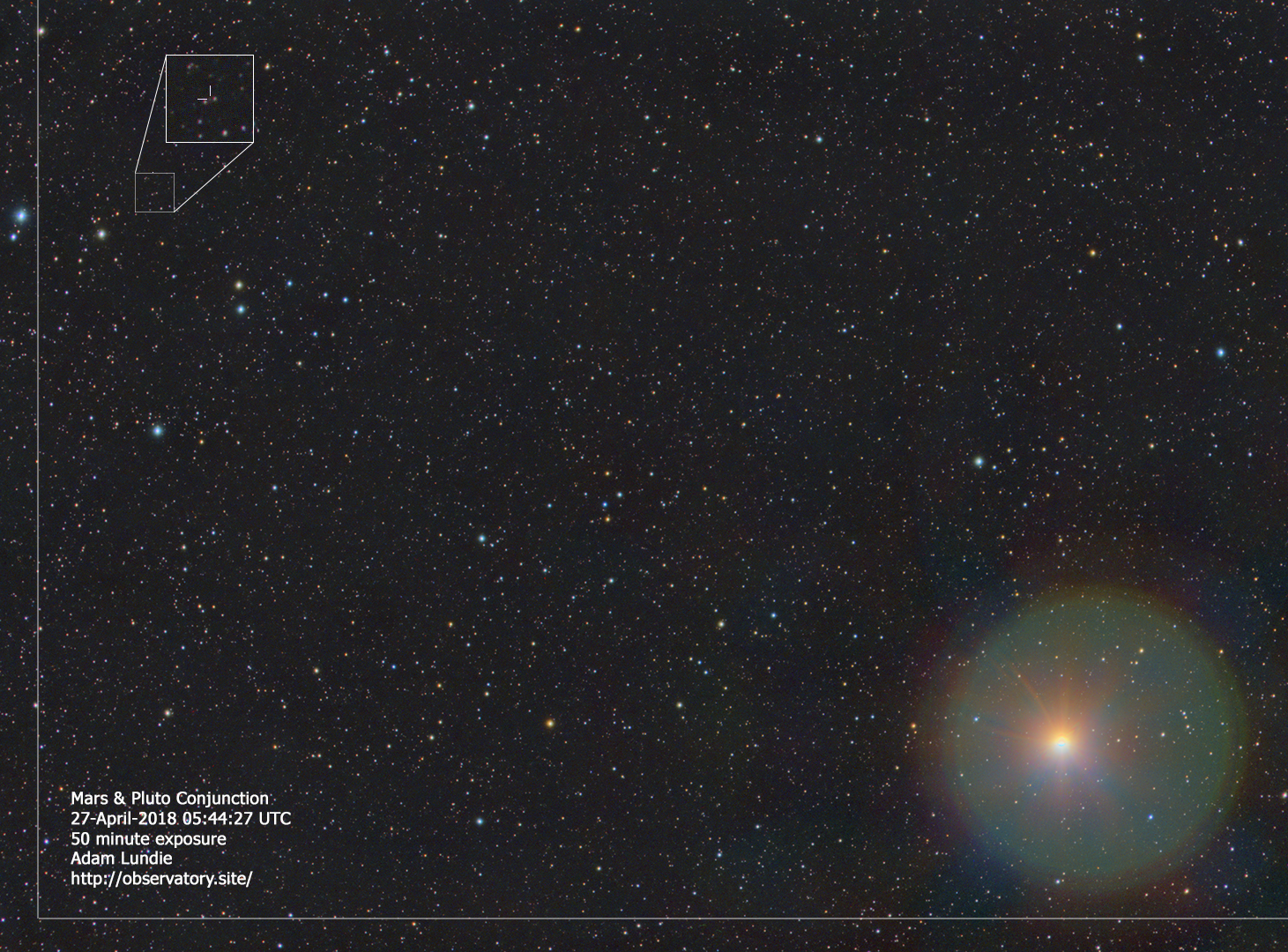 ↗
02-May-2018Mars
Mars and Pluto Conjunction
For a period of three mostly cloudy nights, the planet Mars and Pluto were within 1.5 degrees of each other.
Read the session notes ↗ ↗
25-Apr-2018NGC5367
Reflection Nebula NGC5367
NGC5367 is a reflection nebula 2000 light years in the Centaurus constellation. The bright blue stars illuminate the otherwise dark molecular cloud complex.
Read the session notes ↗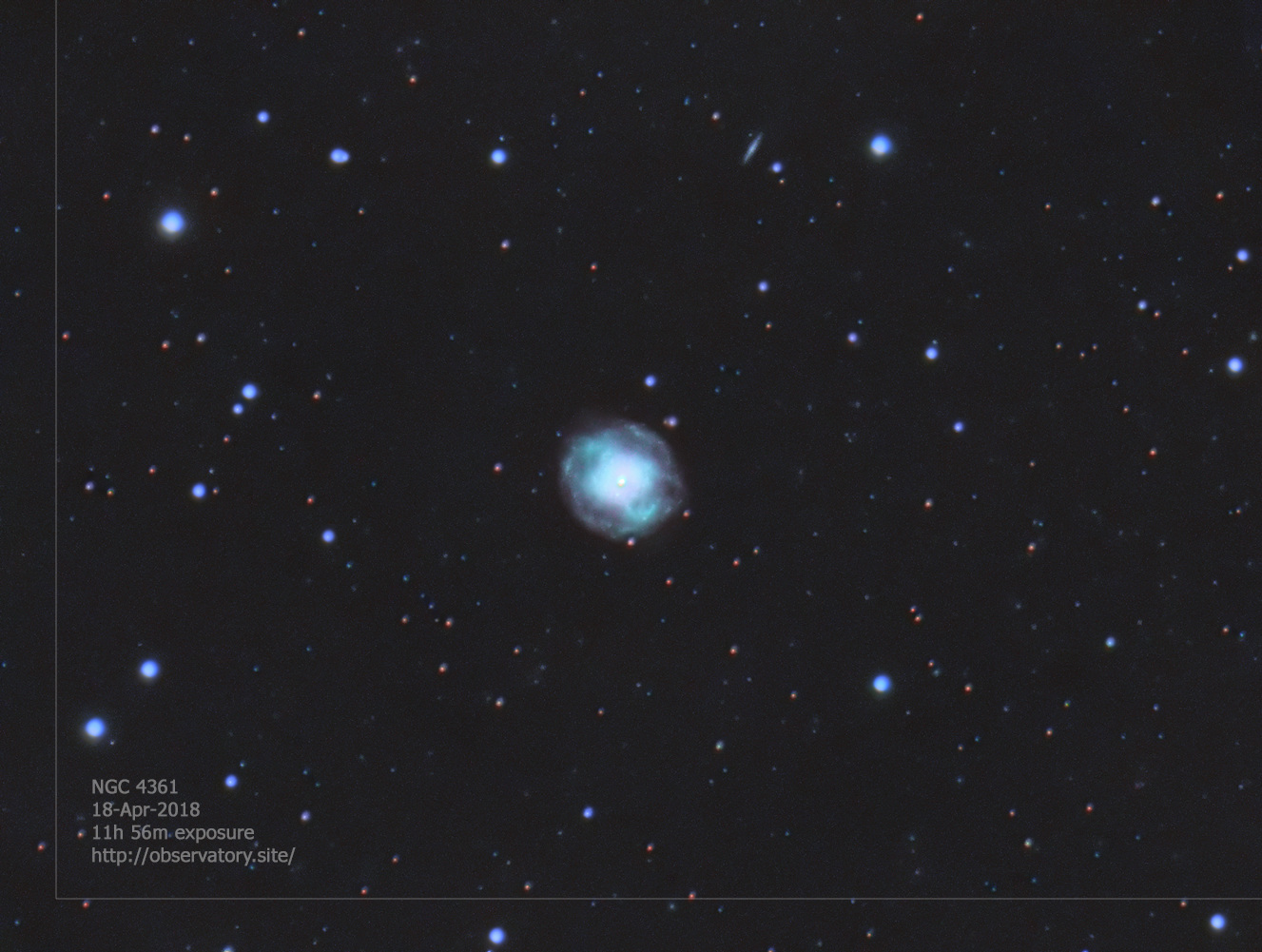 ↗
18-Apr-2018NGC4361
Planetary Nebula NGC4361
NGC4361 is a planetary nebula with spiral arms similar to a galaxy. The star at the center of the nebula is shedding its outer layers while contracting to form a white dwarf.
Read the session notes ↗